
Compound Interest Explained: Formula, Real Examples, and the Rule of 72
Quick Answer
How does compound interest work?
Compound interest earns returns on both your original principal and previously accumulated interest. A $10,000 investment at 6% compounded annually grows to $17,908 after 10 years, not $16,000 as simple interest would produce. The longer money compounds, the larger the gap becomes. Use the Rule of 72: divide 72 by your interest rate to find how many years it takes to double your money.
On this page
For three years I was calculating my savings growth wrong. I knew the interest rate on my account. I knew my balance. I did $10,000 times 5% in my head, got $500, and assumed that was the annual number every year, flat, forever. Like clockwork. $500 per year, simple, permanent. I was doing simple interest math on an account that actually compounds, and the difference between those two things is the whole story of why my savings felt so disappointing for so long.
When I finally ran the actual compound interest formula, I sat with it for a while. Not because the numbers were dramatically different in year one. They weren’t, not really. But over ten years, twenty, thirty, the gap between what I had been imagining and what was actually possible became genuinely embarrassing. I had been thinking about my money the wrong way at a fundamental level, and nobody had ever corrected me because it turns out most people are doing the same thing.
Compound interest is interest earned on interest, not just on the original amount. That sentence sounds obvious until you trace through the actual math and see what it produces over twenty years. Then it changes how you think about savings accounts, investment timelines, credit card debt, and almost everything else in personal finance. This is compound interest explained the way I needed it explained, with real numbers and no jargon, from someone who embarrassingly needed it explained late.
Simple interest vs compound interest: the difference that actually matters
Simple interest is the version most of us learn first, probably because it is easy to calculate. You multiply the principal by the rate by the number of years. That is it.
Take $10,000 at 6% for 10 years. Under simple interest, you earn $600 every year. Ten years later you have $16,000. Clean math, easy to track, and almost completely unlike how real savings accounts and investments actually work.
Now run the same $10,000 at 6%, but compounded annually. In year one, you earn $600 and your balance becomes $10,600. In year two, you earn 6% on $10,600, which is $636, not $600. Year three you earn 6% on $11,236. And so on. After 10 years, you have $17,908. Not $16,000. The compound interest vs simple interest gap on the exact same inputs is $1,908.
Compound that same $10,000 monthly instead of annually and you reach $18,194 after ten years. A few hundred dollars more, on the same principal, at the same rate, just by having interest calculated more frequently. The frequency matters because the more often interest is added to your balance, the more often the next round of interest has a larger base to work from. Daily compounding earns more than monthly. Monthly earns more than annual. Not dramatically on small amounts in short windows, but over decades the differences compound just like the interest does.
This is the whole point of compound interest explained simply: the base keeps growing. Simple interest earns on the original amount forever. Compound interest earns on an amount that gets bigger every period, which means every future calculation is working from a higher starting point than the one before.
Definition
What is the time value of money?The time value of money is a financial concept stating that money available now is worth more than the same amount in the future because of its potential earning capacity. This core principle underlines why compounding works better the earlier you begin.
Historical Context
The ancient origins of compound interest
Historical records show that compound interest was used in ancient Babylon as early as 2000 BC. Clay tablets display math exercises where students calculated how long it would take for a savings deposit to double at an annual interest rate of 20%, showcasing that human interest in exponential growth patterns dates back four thousand years.
In modern finance, the Federal Reserve Survey of Consumer Finances highlights that the average American household keeps its cash in traditional bank savings accounts paying under 0.4% interest. By not switching to high-yield savings accounts that compound at 4% to 5%, households collectively miss out on billions of dollars in interest every year.
The best way I have found to understand how does compound interest work in practice is to look at someone who has been compounding for a very long time. Warren Buffett started investing at 11. By 30 he had about $1 million. By 60, $3.8 billion. By 90, $84 billion. The majority of his wealth came after age 60. Not because he got better at investing in his seventies, but because the compounding that started in his twenties had been running for fifty years. That is not a story about genius. It is a story about time and how compound growth accelerates as the base gets larger.
I am not suggesting anyone expects Buffett-level returns. The point is structural. How does compound interest work? It works by making time the most valuable input in the equation. A higher rate helps. Starting earlier helps more.
The compound interest formula (nobody actually memorizes)
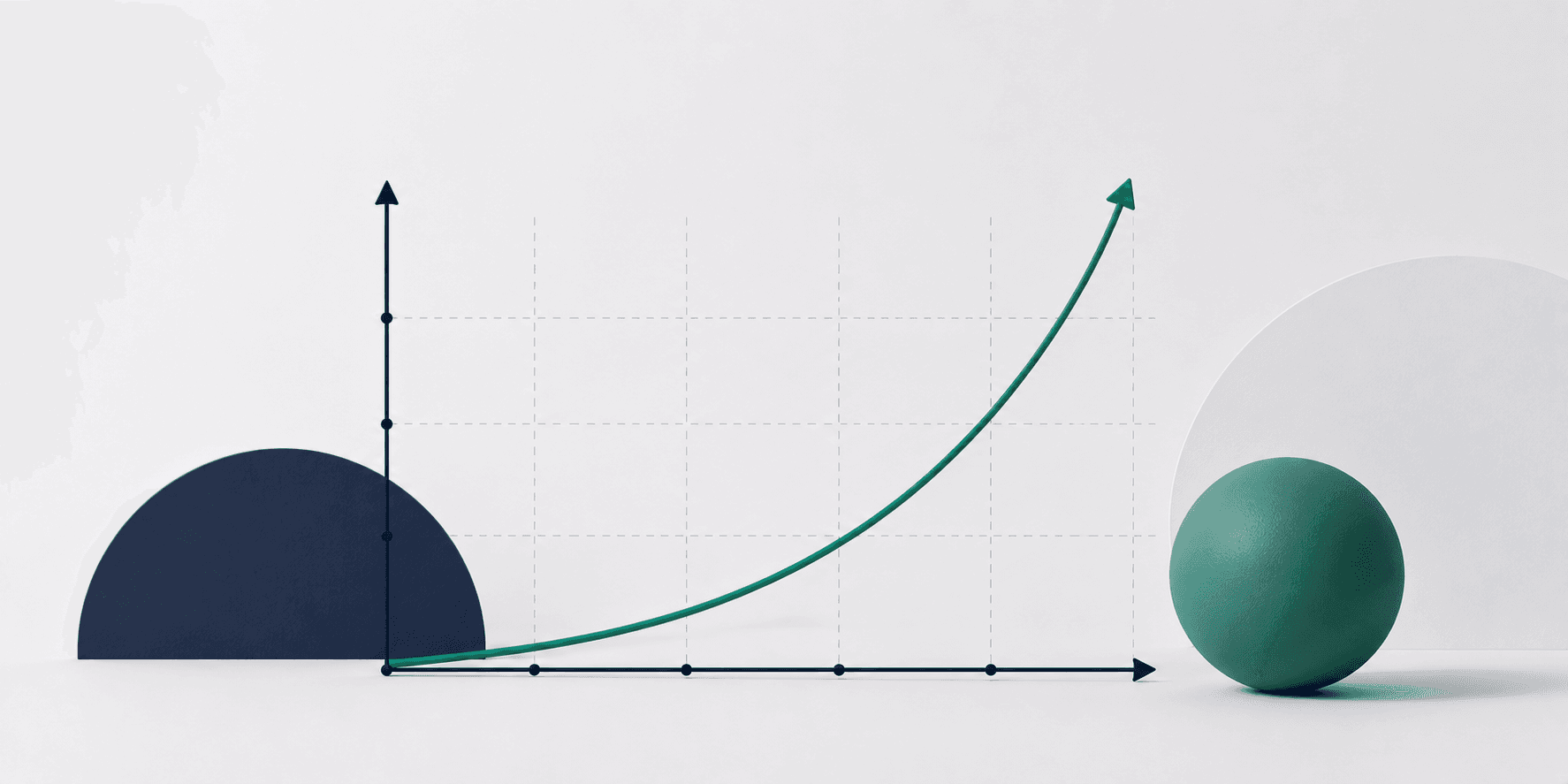
The formula is A = P(1 + r/n)^(nt). It looks scarier than it is. Spelled out:
- A is the final amount you end up with
- P is your principal, the starting amount
- r is the annual interest rate as a decimal (6% becomes 0.06)
- n is how many times interest compounds per year
- t is the number of years
Use it with the numbers from before. $10,000 at 6% compounded monthly for 10 years. P is 10,000, r is 0.06, n is 12 (monthly), t is 10.
A = 10,000(1.005)^120
A = 10,000 x 1.8194
A = $18,194
I do not memorize the compound interest formula. I never have. What I do remember is what each piece does: more compounding periods means bigger n, which means faster growth. More time means bigger t, which matters more than almost anything else in the formula. A higher rate helps, but time is the real lever. The difference between starting at 25 and starting at 35 is not ten years of contributions. It is ten years of compounding on everything that came before.
One thing the formula makes clear that the simple version never did: when you see a savings account advertising a rate, check whether it is APR or APY. APR is the annual rate before compounding. APY folds in the compounding frequency and shows what you actually earn over a year. A 5% APR compounded monthly equals a 5.12% APY. Small gap on $1,000. Real money on $100,000 over two decades. When comparing savings accounts, always compare APY.
| Compounding Frequency | Compounding Periods/Year | Effective APY | Interest Earned (10 Years) | Final Balance (10 Years) |
|---|---|---|---|---|
| Simple Interest (No Compounding) | 0 | 5.00% | $5,000.00 | $15,000.00 |
| Annually | 1 | 5.00% | $6,288.95 | $16,288.95 |
| Quarterly | 4 | 5.09% | $6,436.19 | $16,436.19 |
| Monthly | 12 | 5.12% | $6,470.09 | $16,470.09 |
| Daily | 365 | 5.13% | $6,486.62 | $16,486.62 |
If you want to skip the algebra and just run your own numbers, the Vortenza compound interest calculator handles all of this. Plug in a starting balance, a rate, a compounding frequency, and a time horizon and it shows you the full growth curve. Useful for testing what a different APY on your savings account would actually add up to.
How do you calculate annual compound interest?
To calculate annual compound interest, you must multiply the principal amount by one plus the annual interest rate raised to the power of the number of years. This calculation adds the interest from each year back to the principal before calculating the next year's return.
For example, a $1,000 principal at a 5% interest rate grows to $1,050 in year one. In year two, the 5% interest is calculated on $1,050, resulting in a balance of $1,102.50. By year ten, the balance reaches $1,628.89, compared to $1,500 under simple interest.
The Rule of 72: the only compound interest math you actually need
The Rule of 72 is the only mental shortcut I actually use with any regularity now. Divide 72 by your interest rate and you get a rough estimate of how many years it takes to double your money. No formula, no calculator.
| Interest rate | Years to double (Rule of 72) |
|---|---|
| 4% | 18 years |
| 6% | 12 years |
| 8% | 9 years |
| 12% | 6 years |
| 24% (credit card APR) | 3 years |
The savings side of this is motivating. The debt side is the number that hit me hardest when I first worked through it. A credit card charging 24% APR doubles what you owe in three years if you are only making minimum payments. Not add 24%. Double. Three years is nothing. I had a balance I had been carrying for over two years while thinking of it as fine, manageable, under control. Running the Rule of 72 on it changed that. Three more years and it would be twice as large, and I would have contributed to that doubling by doing nothing more than making minimum payments.
The Rule of 72 is genuinely useful because it makes the math instant and personal. You do not need a calculator. You do not need the compound interest formula. You just need the rate and a few seconds of arithmetic. I use it constantly now, mostly as a gut-check on whether a rate is actually good or just sounds good.
Real compound interest examples with actual numbers
Abstract math is easy to understand and easy to forget. Real numbers are harder to dismiss. Here are three scenarios where how does compound interest work becomes visible in a way that changes behavior.
The high-yield savings account switch
$15,000 sitting in a regular bank savings account at 0.01% APY for four years earns $6 total. I want to be clear about that number. Six dollars. Not per year. Total. After four years.
The same $15,000 in a high-yield savings account at 4.8% APY earns approximately $720 in the first year alone. That is a $714 annual difference on money sitting in the exact same position doing nothing, just held somewhere with a better rate. The effort required to switch is an afternoon. The gap in returns is real money, not a rounding error.
In 2026, high-yield savings accounts are paying 4.5 to 5.2% APY. Regular bank accounts are paying 0.01% to 0.5%. If your savings account APY has a zero in front of the decimal, you are leaving hundreds of dollars per year on the table for no reason other than inertia.
Monthly contributions over 30 years
$200 per month at 7% annual return, compounded monthly, for 30 years. You contribute $72,000 total over those three decades. The final value is approximately $243,000.
That $171,000 difference between what you put in and what you end up with is entirely compound interest at work. Every dollar you contributed kept earning, and those earnings kept earning on top of themselves. You did not invest $243,000. You invested $72,000 and the compounding did the rest.
Starting 10 years late
Same setup, same $200 per month, same 7%, but you start ten years later and only invest for 20 years instead of 30. Final value: approximately $104,000.
Starting a decade earlier nearly tripled the outcome on identical monthly contributions. Those extra ten years of compounding added $139,000. Not because you invested more money, you invested $48,000 more total, but because compound interest needs time to accelerate, and the early years generate the foundation that the later years multiply. This is the number I come back to whenever I feel like a small monthly amount is not worth the effort.
I am not sure this generalizes to every situation, and I would never tell someone in a financial tight spot to prioritize investing over stability. But if you have any slack in your monthly budget and you are not already putting some of it somewhere that compounds, the math above is the honest case for starting anyway, even if the amount feels small. Compound interest real examples always make the same point: the variable that matters most is how long the money has been running.
Where compound interest works against you

Most people understand savings better than they understand borrowing, which is a strange thing given that borrowing is where the math usually hurts more.
Credit cards mostly compound daily. Not annually. Not monthly. Daily. At APRs that typically run 20 to 29%. Take $5,000 in credit card debt at 24% APR, make minimum payments only, and you are looking at roughly 17 years to pay it off and about $7,800 in interest charges. You borrowed $5,000 and paid back over $12,000.
That is daily compound interest working against you on exactly the same mathematical principle as the savings examples above. The formula is identical. The only difference is direction. Understanding how does compound interest work is just as important for debt as it is for savings, maybe more so, because the rates are higher and the compounding is more frequent.
A 24% stated APR sounds manageable in isolation. Run the Rule of 72 on it: that balance doubles in three years. Then doubles again in three more. Saying the number out loud is different from watching what it actually does to a balance over time. For anyone wondering how does compound interest work on debt specifically, the answer is the same formula, the same compounding frequency logic, just running in the direction that costs you money instead of making it.
I think about this every time someone says they “only” have a few thousand dollars in credit card debt. A few thousand at 24%, compounding daily, with minimum payments only, is not a minor inconvenience. It is a seven-year commitment to paying back more than you borrowed. Understanding compound interest on debt is not just academic. It changes what you do next month.
For the mortgage equivalent of this math, where compounding on large debt plays out across decades, the mortgage payment calculator shows the full breakdown of interest versus principal across a loan term.
Compound interest FAQ
What is the difference between APR and APY?+
How often do savings accounts compound?+
Does compound interest apply to stocks?+
What is a good interest rate for compound growth?+
Is compound interest the same as compound growth?+
What is a good compound interest rate for savings in 2026?+
How much will $10,000 grow in 10 years with compound interest?+
Does compound interest apply to retirement accounts?+
What is the difference between APR and APY in compound interest?+
How does inflation affect compound interest returns?+
What is the difference between daily and monthly compounding?+
How does dividend reinvestment relate to compound interest?+
What is the time value of money?+
Is compound interest taxable?+
The math here is not complicated. What makes compound interest feel complicated is that the results take time to become visible, and most people never bother to project forward far enough to see what is actually happening. $200 a month at 7% does not feel like $243,000 in year two. It does in year thirty.
Most people leave money in accounts paying 0.01% because switching feels like effort, which I genuinely understand, because I did it for four years. They carry credit card balances without calculating what the daily compounding actually costs over five years. They do not think about whether they are ten years early or ten years late on an investment habit that will compound for decades either way. The math rewards knowing it. Ignoring it costs real money in real accounts.
Do one thing today. Look up the APY on your current savings account. If it is under 1%, you already know what to do. Then run your actual numbers through the compound interest calculator: your current balance, your current rate, your realistic time horizon. See what 10, 20, and 30 years of compounding actually produces on the money you already have. Then run it again with the high-yield rate you could be getting. The difference between those two numbers is the real cost of inertia.
If you are also thinking about the tax side of savings and investment income, our tax deductions guide covers self-employment income and the retirement accounts that get you compounding inside a tax shelter at the same time. And if you are still deciding whether freelancing versus a salary is the right financial move, the freelance vs salary comparison runs those numbers side by side, including what compound growth looks like when you are funding your own retirement instead of relying on an employer match.
Sources and academic references
About this guide
Written by the Vortenza Editorial Team. We build free financial calculators and practical guides for freelancers, savers, and anyone trying to make better decisions with their money. The perspective in this guide comes from someone who spent three years mentally calculating simple interest on a compound account, then spent the next year mildly obsessed with making up for it.
Related tools
Related Guides
Freelancer Tax Deductions 2026: Every Deduction You Can Claim
FinanceSelf-Employment Tax Guide 2026: How SE Tax Works
FinanceFreelance vs Salary 2026: Real Financial Comparison
FinanceHow to Calculate Mortgage Payment 2026
FinanceFederal Income Tax for Freelancers 2026
FinanceFreelance Hourly Rate Calculator 2026: Set Your Real Rate